Product family
V Bank HEPA Filters
A V bank filter arranges multiple media packs in a V shaped assembly. The geometry can support higher media area in a compact face size, but every performance value must stay tied to the tested configuration and airflow.
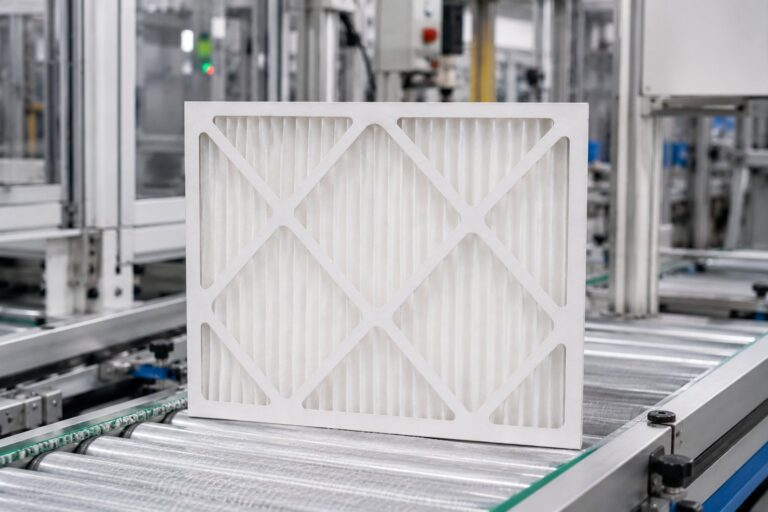
Specification boundary: Published values will be added only when they are linked to the exact product, model, standard and test condition.
Construction and use
Define the configuration before comparing performance.
A V bank filter arranges multiple media packs in a V shaped assembly. The geometry can support higher media area in a compact face size, but every performance value must stay tied to the tested configuration and airflow.
This page describes a product family rather than one fixed model. A quotation should identify the exact construction and confirm which values belong to that configuration.
- Product level
- Finished Filter
- Geometry
- Size, depth, interface
- Performance
- Standard and conditions
- Evidence
- Model-specific source
Specification inputs
Record these fields on the same technical request.
Keeping these variables together reduces the risk of comparing values from different media packs, frames or test conditions.
| Field | What to provide | Why it matters |
|---|---|---|
| Application | System, device or environment | Sets the operating context and relevant risks |
| Dimensions | Length × width × depth and tolerance | Confirms fit and available media pack space |
| Efficiency | Standard and required class or grade | Prevents percentage comparisons across methods |
| Airflow | Rated airflow or face velocity | Keeps resistance and performance comparable |
| Pressure limit | Initial resistance target at the stated airflow | Protects the system pressure budget |
| Construction | Frame, media, support, separator and seal | Defines the exact product configuration |
| Environment | Temperature, humidity and contaminants | Identifies material and service constraints |
| Project | Quantity, drawing or sample, destination | Supports feasibility and quotation review |
Datasheet review
Read the conditions before reading the headline value.
A useful datasheet identifies the product or model, construction, dimensions, test method and the airflow or face velocity used for each performance result. If a table combines several grades, confirm which column belongs to the requested configuration and whether the units and conditions stay the same.
Check revision dates as well. A value from an older brochure may describe a different media source, pack depth, frame or test setup. When two documents disagree, do not average the numbers or select the more attractive one. Ask for the current model-specific source and record the approved revision with the quotation.
The same rule applies after a custom change. A different depth, media, frame, separator or seal can change the finished filter result, so the earlier data should be treated as a reference until the revised configuration is confirmed.
Application boundary
Use the product family as a starting point, not a guaranteed fit.
Suitability depends on the full system specification. A product name alone does not confirm efficiency, temperature capability, chemical compatibility, service life or replacement interval.
- Do not transfer a value between models or frame constructions
- Do not compare resistance at different airflows
- Do not infer certification from a product category
- Do not assume device or brand compatibility without a verified match
Prepare a workable enquiry
Match the quote to your actual operating conditions.
Send the application, dimensions, efficiency standard, airflow or face velocity, pressure drop limit, materials, seal, quantity and destination when available.